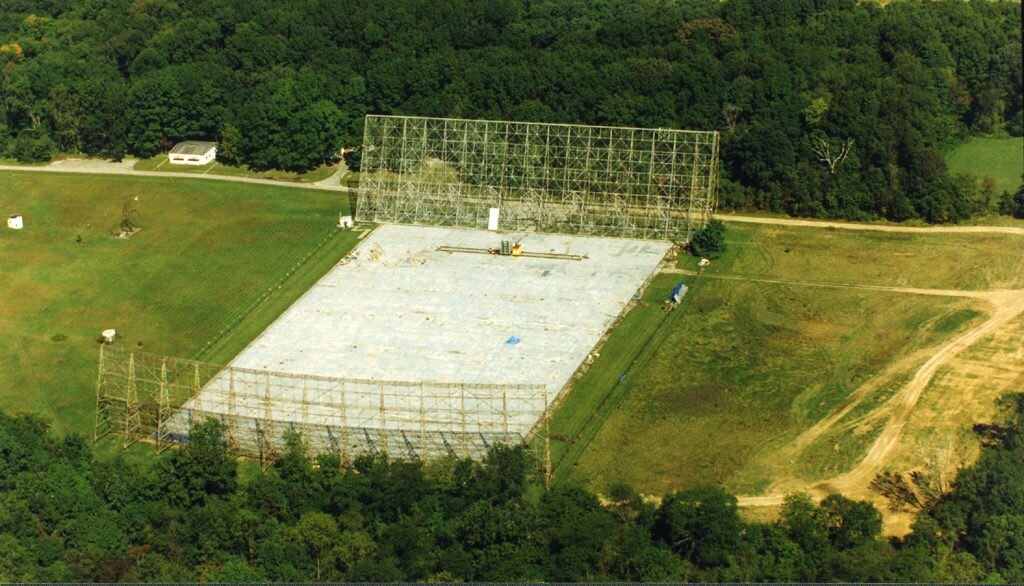
On a quiet August night in 1977, something extraordinary happened in the Ohio countryside that would captivate scientists and alien enthusiasts for nearly five decades. While most people were sleeping, a radio telescope called Big Ear picked up what appeared to be the first genuine message from an extraterrestrial civilization. The signal was so remarkable that when astronomer Jerry Ehman spotted it on a computer printout days later, he circled it in red ink and wrote one word in the margin that would become legendary: “Wow!”
The discovery has sparked decades of debate, multiple investigations, and countless theories about what really happened that night. Recent research suggests we might finally have answers, though they’re probably not the ones alien believers were hoping for.
The signal matched exactly what scientists expected from aliens.
The Wow! Signal wasn’t just any random radio burst from space. It hit all the marks that researchers had predicted an alien message would have. The frequency was 1420 MHz, right near the hydrogen line, which is the same wavelength that hydrogen atoms naturally emit throughout the universe.
Scientists had long theorized that any intelligent civilization trying to communicate would choose this frequency because hydrogen is the most common element in the cosmos. Any technologically advanced species would know that astronomers everywhere would already be listening to this wavelength, making it the perfect cosmic telephone line.
It was impossibly strong and perfectly focused.
The signal lasted exactly 72 seconds, which was the full time that Big Ear could observe that patch of sky as Earth rotated. Its intensity was off the charts, about 30 times stronger than the usual background radio noise from space. Even more intriguing, it was incredibly narrow in frequency, like a finely tuned radio station rather than the broad-spectrum noise that natural cosmic objects typically produce.
The precision and power of the transmission suggested something artificial rather than natural. No known astronomical phenomenon could produce such a focused, intense signal at that specific frequency.
Jerry Ehman was just a volunteer who stumbled onto history.
He wasn’t even a full-time astronomer when he made what might be the most significant discovery in human history. He was volunteering at Ohio State University’s SETI project, spending his free time analysing stacks of computer printouts looking for anything unusual in the radio telescope data.
The Big Ear telescope operated automatically, collecting data for days before someone would show up to collect the printouts. Ehman’s job was to scan through these massive sheets of numbers looking for anomalies. Needless to say, that was ttedious work that rarely produced anything interesting. On August 17, 1977, two days after the signal was received, that all changed.
The telescope was built on a shoestring budget by volunteers.
Big Ear wasn’t some massive, well-funded facility. It was essentially a giant DIY project. The radio telescope was constructed in the 1960s by university staff, volunteers, and part-time workers using National Science Foundation funding. Instead of a traditional dish, it used a unique flat reflector design that was 340 feet long and 100 feet tall.
The entire operation ran on about $100,000 per year from NASA, with much of the work done by unpaid volunteers like Ehman. This grassroots approach made the discovery even more remarkable. Humanity’s best candidate for alien contact was found by dedicated amateurs working with improvised equipment.
The signal appeared to come from empty space.

When astronomers pinpointed where the Wow! Signal originated, they found nothing there: no star, no galaxy, no obvious source. The coordinates pointed to a region in the constellation Sagittarius that appeared completely unremarkable. This absence of any visible source made the signal even more mysterious.
Follow-up observations of the same area using more powerful telescopes found absolutely nothing. If aliens had built some kind of transmitter there, it was either invisible to our instruments or had been shut off immediately after the transmission.
It never repeated despite decades of searching.
The most frustrating aspect of the Wow! Signal is that it happened once and never again. Ehman and other astronomers searched the same area of sky for months afterward using Big Ear, finding nothing. More sensitive telescopes have been pointed at those coordinates dozens of times over the years, but the signal has never returned.
This one-time occurrence puzzled scientists, who expected that any genuine alien message would repeat, like a beacon trying to attract attention. The lack of repetition led some to wonder if it might have been a brief, accidental transmission that was quickly silenced.
Recent research suggests it might have been cosmic fireworks.
In 2024, astronomers proposed a new explanation that could finally solve the mystery. Using modern analysis techniques on archived data from the Arecibo Observatory, researchers found similar but much weaker signals in the same frequency range. These turned out to be cold hydrogen gas clouds in space.
The theory suggests that the Wow! Signal was created when a rare cosmic event, possibly a flare from a magnetar, an incredibly dense star with a massive magnetic field, struck a cloud of hydrogen gas and caused it to suddenly brighten like a cosmic flashbulb. The timing had to be perfect for Earth to catch this brief burst.
The explanation involves “astronomical anarchy” that’s never been seen before.
The proposed hydrogen cloud theory requires an incredibly specific and rare chain of events. A magnetar would need to release a powerful burst of radiation at exactly the right angle to hit a hydrogen cloud, which would then need to act like a natural laser (called a maser) and beam the signal directly toward Earth.
Scientists describe this as an extremely rare kind of astrophysical anarchy, largely because it involves multiple unlikely events happening simultaneously. The phenomenon would be so uncommon that it might occur only once in decades or centuries, which would explain why the signal never repeated.
Similar signals have been detected since then, but they’re much weaker.

The research team found multiple instances of signals similar to the Wow! Signal in archived data from the Arecibo Observatory, but these were about 100 times weaker. They were easily identified as emissions from small, cold hydrogen clouds scattered throughout the galaxy, which are the same type of clouds that might have produced the original signal.
The difference in intensity suggests that the Wow! Signal was caused by the same type of hydrogen cloud, but one that had been dramatically energized by some powerful cosmic event. Without that extra energy boost, these clouds produce only faint background signals.
The Big Ear telescope was demolished just as technology improved.
Tragically, the Big Ear radio telescope was destroyed in 1998, just as computing power and signal analysis techniques were becoming sophisticated enough to better understand phenomena like the Wow! Signal. The demolition came after Congress cut funding for SETI research in 1993, eliminating the telescope’s annual operating budget.
If the Big Ear were still operating today with modern equipment, astronomers might have been able to detect and analyse similar signals in real-time, potentially solving the mystery decades ago. The timing of its destruction represents one of astronomy’s great “what if” moments.
Jerry Ehman was always sceptical of the alien explanation.
Despite discovering what many consider the best evidence for alien contact, Jerry Ehman himself was cautious about jumping to extraterrestrial conclusions. In 1994, he suggested the signal might have been reflected off space debris, though he later backed away from this explanation when further research showed it was unlikely.
In a 2019 interview, Ehman stated that he was “convinced that the Wow! signal certainly has the potential of being the first signal from extraterrestrial intelligence,” but he maintained scientific scepticism throughout his life. He understood that extraordinary claims required extraordinary evidence.
The frequency was in a protected radio spectrum.

The 1420 MHz frequency where the Wow! Signal was detected is part of a protected spectrum reserved exclusively for astronomical research. Terrestrial transmissions are forbidden in this frequency range specifically to prevent interference with radio astronomy observations.
This protected status made the signal even more intriguing because it ruled out most earthly sources of interference. While some terrestrial sources have been documented illegally transmitting in this range, the intensity and characteristics of the Wow! Signal didn’t match typical human-made transmissions.
The discovery helped launch modern SETI programs.
The Wow! Signal became a rallying point for the search for extraterrestrial intelligence, inspiring increased funding and interest in SETI programs worldwide. Its discovery demonstrated that radio telescopes could potentially detect alien transmissions, giving credibility to the idea that we should be actively listening for extraterrestrial messages.
Even if the signal turns out to be natural, it proved that our technology was capable of detecting the kind of focused, powerful transmissions that an alien civilization might send. This proof of concept helped justify continued investment in SETI research and more sophisticated listening programs.
Modern technology would handle a repeat very differently.
If something like the Wow! Signal happened today, the response would be completely different. Modern radio telescope arrays like the Allen Telescope Array can instantly alert astronomers to unusual signals, allowing for immediate follow-up observations while the signal is still active.
Current SETI programs also use machine learning and automated detection systems that can spot anomalies in real-time, rather than waiting days for human analysts to review printed data. A signal detected today would trigger a coordinated response from multiple observatories around the world within minutes.
The mystery inspired plenty of citizen science projects.

The enduring puzzle of the Wow! Signal has inspired amateur astronomers and citizen scientists to build their own radio telescopes and join the search for similar signals. Projects like SETI@Home allowed millions of people to help analyse radio telescope data using their home computers.
More recently, the Wow@Home project was created specifically to search for Wow!-like signals using networks of small radio telescopes. The idea is that many small, inexpensive telescopes operating continuously might catch rare events that large professional observatories miss because they can’t monitor the sky 24/7.
To this day, it’s still the gold standard for potential alien signals.
Despite nearly 50 years of searching and multiple attempts to explain it away, the Wow! Signal remains the most compelling candidate for an extraterrestrial transmission ever detected. Even if the new hydrogen cloud explanation proves correct, it established the template for what scientists should look for when searching for alien communications.
The signal demonstrated that genuine alien messages might be brief, powerful, and easily missed if we’re not paying attention. Whether it was aliens, magnetars, or something else entirely, the Wow! Signal changed how we think about our place in the universe and reminded us that sometimes the most extraordinary discoveries come from the most ordinary people doing extraordinary work.