Getting older doesn’t have to mean a slow slide into stiffness and constant groaning every time you get off the sofa.

We tend to accept losing our range of motion as an inevitable part of the calendar moving forward, but the truth is that your biological age and the number on your birth certificate don’t always have to match. If you’ve reached 45, and you can still handle certain physical movements without a second thought, you’re effectively beating the clock. It is about more than just being fit; it’s about having a body that still functions with the fluid ease of someone 20 years younger.
The real marker of ageing in reverse is functional mobility—the kind that allows you to live your life without worrying if your back is going to go out or if your knees can handle a flight of stairs. Most people start to lose their balance, their flexibility, and their core strength bit by bit until their world starts to shrink. But if you’ve kept up with your maintenance and can still pull off these specific moves, you’re in a different league entirely. These physical markers are a sign that you’re keeping your youth on the inside, regardless of what the candles on your cake say.
1. You can get up off the floor without using your hands.

This is one of the clearest markers of long-term mobility. Being able to sit on the floor and stand back up using just your legs means your joints, balance, and strength are still working together properly. Most people lose this skill gradually without noticing until it’s gone.
Movement researchers care about this because it reflects real-world independence. It shows your muscles still communicate well, your hips still move freely, and your balance hasn’t been destroyed. It’s a simple test that reveals far more than any gym lift ever could.
2. You can squat comfortably without your heels lifting.

A deep squat requires ankle mobility, hip flexibility, knee health, and core control all at once. If your heels stay down and your back stays relaxed, your lower body is still moving like it’s meant to. Many adults lose this by their mid-40s.
This matters because squatting is tied to everyday tasks like picking things up or getting low without strain. When this movement stays intact, it usually means your joints are ageing evenly instead of locking up in certain areas.
3. You can turn your head fully without stiffness.

Neck mobility often disappears silently but surely. If you can still turn your head easily while driving or checking behind you, that’s a strong sign your spine hasn’t stiffened prematurely. Many people adapt to limited movement without realising it.
Scientists watch this closely because neck stiffness often reflects overall spinal health. When the neck stays mobile, it usually means posture, muscle tone, and joint health across the upper body are still holding up well.
4. You can walk briskly without joint pain.

Walking shouldn’t hurt. If you can still move at a decent pace without knee, hip, or ankle pain, your joints are ageing well. Pain-free walking shows cartilage, tendons, and muscles are sharing the workload properly.
Researchers see walking speed as a key ageing marker. People who maintain a strong, confident walk tend to preserve independence and overall health far longer than those who slow down due to discomfort.
5. You can balance on one leg without wobbling.
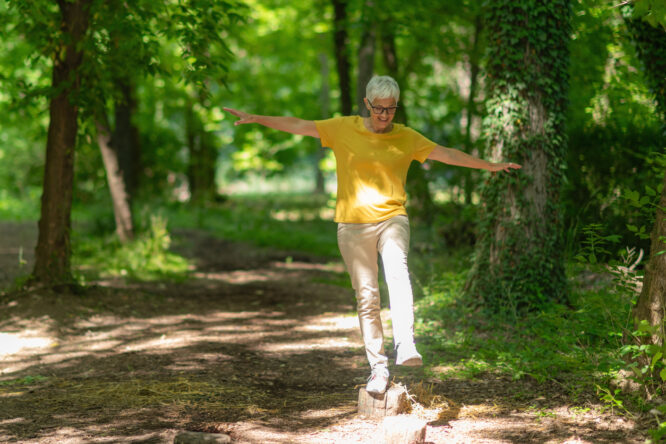
Single-leg balance might seem trivial, but it’s a big deal after midlife. If you can stand on one leg for 30 seconds without flailing, your nervous system is still sharp and responsive.
This ability protects against falls, which are one of the biggest ageing risks. Balance relies on muscle strength, joint awareness, and brain coordination, so when it’s strong, many systems are ageing well together.
6. You can reach overhead without strain.

Being able to lift your arms fully overhead without pain or tightness suggests healthy shoulders and an adaptable upper spine. Many adults slowly lose this range and start compensating with awkward movements.
Movement experts worry about overhead stiffness because it often signals long-term postural issues. When overhead movement stays easy, it usually means the shoulders and spine haven’t been stuck in survival mode for years.
7. You can twist your torso smoothly.
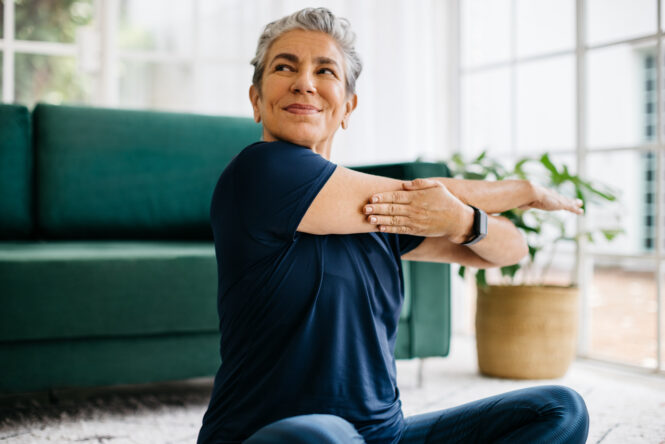
Rotational movement often disappears before people notice. If you can still twist easily to look behind you or reach sideways without feeling stuck, your spine is ageing gracefully.
This matters because rotation supports balance, coordination, and injury prevention. Scientists see good rotational ability as a sign that joints and connective tissue haven’t become overly rigid with age.
8. You recover quickly after physical effort.

It’s not about never getting sore. It’s about bouncing back. If your body feels ready to move again within a day or two, your recovery systems are still efficient.
Researchers pay close attention to recovery because slow recovery often signals chronic inflammation or poor sleep. Quick bounce-back suggests your body still repairs itself effectively.
9. You can sit for a while and stand up without stiffness.

That first step after sitting tells a story. If you don’t need to brace yourself or loosen up for minutes, your joints are still well lubricated, and your muscles haven’t gone dormant.
This matters because stiffness after rest often predicts future mobility issues. Staying fluid between sitting and standing shows your body hasn’t started “rusting” between movements.
10. You can move quickly without fear of injury.
Quick movements like stepping aside, catching yourself, or reacting suddenly require confidence in your body. If you still trust your movement, that’s huge after 45.
Scientists see hesitation as an ageing signal. When people stop trusting their body, movement becomes cautious and stiff, which ironically speeds up physical decline.
11. You don’t need a warm-up just to function.

Warm-ups are smart, but needing one just to feel normal can be a warning sign. If your body feels reasonably loose from the start of the day, that’s a sign of good baseline mobility.
This suggests joints, muscles, and connective tissue are still elastic. Movement scientists see this as a marker of youthful tissue quality, not just fitness.
12. Movement still feels natural, not calculated.

The biggest sign of all is ease. If you don’t overthink how you move, your body hasn’t shifted into compensation mode. Many people start planning movements as they age without realising it.
When movement stays instinctive, it usually means strength, balance, and flexibility are still aligned. That combination is rare after 45 and a strong sign your body is ageing slower than average.